El Plan de Trabajo del Proyecto PROCARIBE+ se estructura en torno a cuatro componentes técnicos, con nueve resultados asociados (es decir, resultados de alto nivel). Para lograr estos resultados, se espera que PROCARIBE+ genere un total de 18 productos.
¿DÓNDE Y CON QUIÉN TRABAJAREMOS?
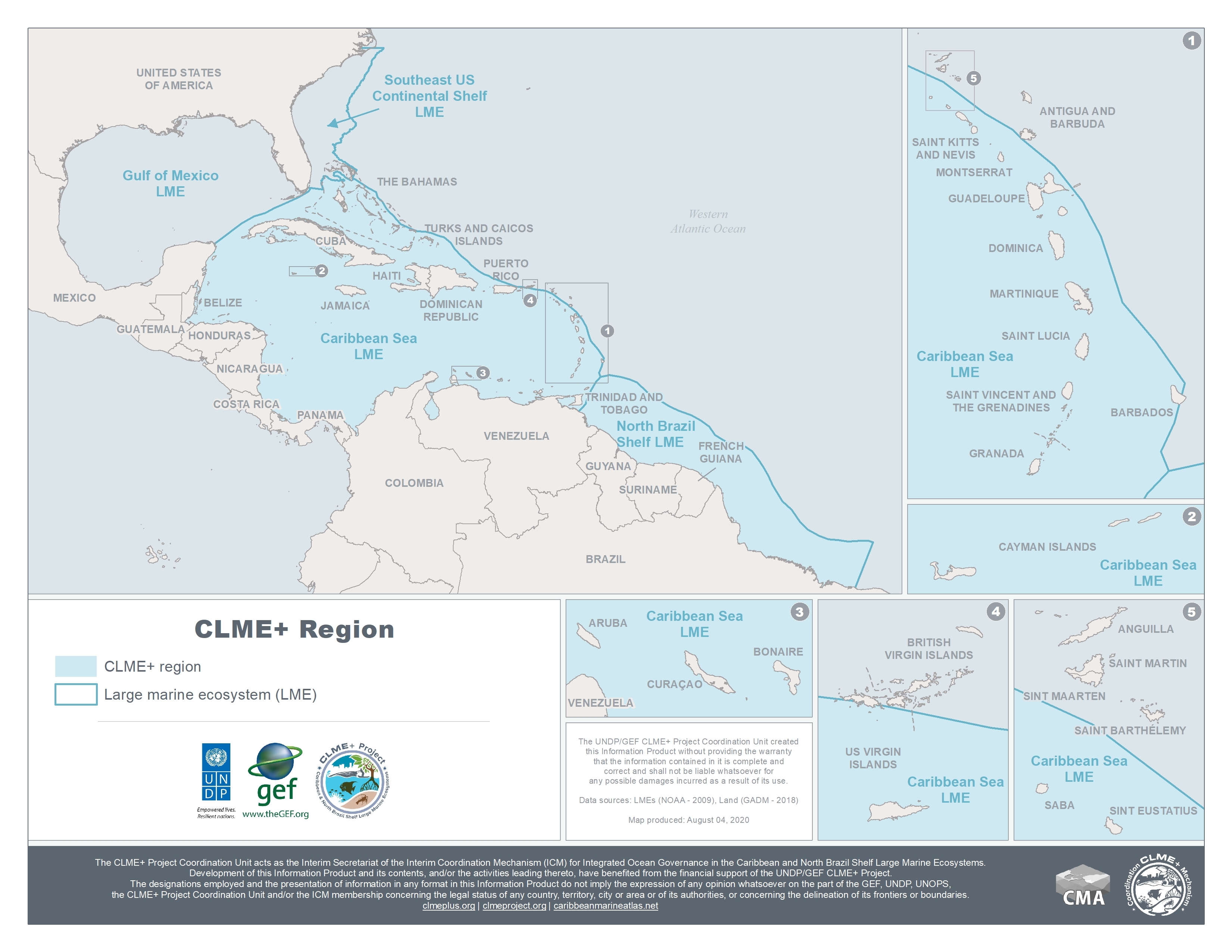
El enfoque principal de PROCARIBE+ se centra en los países de la Región del Gran Caribe (Grandes Ecosistemas Marinos del Caribe y la Plataforma Norte de Brasil).
Ocho productos del proyecto son de alcance regional, es decir, benefician a todos los países de la región, y un producto adicional tiene alcance global.
Para nueve productos, PROCARIBE+ recibe financiamiento del FMAM para actividades específicas de cada lugar. Estas inversiones sobre el terreno se centran en los 19 países elegibles para el FMAM que participaron originalmente en el diseño del proyecto.
Otros países se benefician de una alianza estratégica entre el Proyecto PROCARIBE+ y el Programa de Pequeñas Donaciones del FMAM.
Nota: Muchos de los productos específicos de cada lugar aún incluyen un elemento de intercambio/ampliación de conocimientos a nivel regional.
La siguiente tabla ofrece una descripción general de los componentes, resultados y productos del Proyecto PROCARIBE+, la(s) entidad(es) responsable(s) de la ejecución de cada producto y los países beneficiarios correspondientes.
Nota 1. Los hipervínculos de la tabla llevarán a las páginas de resultados correspondientes, que ofrecen información más específica sobre el trabajo planificado o realizado y los resultados obtenidos. Las páginas de resultados se encuentran actualmente en desarrollo y se irán añadiendo progresivamente.
Nota 2. Puede obtener una versión en PDF más detallada de la tabla de Resultados y Productos, incluyendo objetivos y métricas, aquí.
Todos los países del Gran Caribe
Específico de la ubicación
Específico de la ubicación, con
ampliación/replicación regional
COMPONENTE 1. Fortalecimiento de la Gobernanza Oceánica a nivel regional
RESULTADO 1.1. Implementación coordinada, colaborativa y sinérgica de Programas y Planes de Acción (Estratégicos) regionales, subregionales y nacionales en apoyo de la Visión CLME+, facilitada mediante un Mecanismo de Coordinación Oceánica (OCM) regional y alianzas (temáticas) complementarias, así como un enfoque programático regional.
Apoyo continuo al Programa de Acción Estratégica (PAE) CLME+ 2015-2025
Responsable(s):
Unidad Regional de Proyectos de UNOPS
Producto 1.1.2.b.
Un nuevo Programa de Acción Estratégica (PAE) de “Economía Azul” para la región
Responsable(s):
Unidad Regional de Proyectos de UNOPS
COMPONENTE 2. Creación de capacidad y condiciones propicias a nivel nacional
RESULTADO 2.1. Capacidad, condiciones propicias y compromisos a nivel nacional para la gestión basada en la evidencia (EBM)/EAF y un desarrollo socioeconómico “verde-azul” basado en el mar, resiliente al clima y a los desastres
Producto 2.1.1.
Promoción y apoyo para una mejor coordinación intersectorial nacional
Responsable(s):
Unidad Regional de Proyectos de UNOPS
Producto 2.1.2.
1 prototipo de informe nacional sobre el Estado del Medio Marino y las Economías Asociadas (SOMEE) (Costa Rica)
Responsable(s):
Por confirmar
Resultado 2.1.3.
Capacitación y desarrollo de capacidades para mejorar la gobernanza y la gestión de los recursos marinos
Responsable(s):
PNUMA Secretaría del Convenio de Cartagena, COI de la UNESCO / IOCARIBE
Resultado 2.1.4.
Integración de los activos marinos y costeros en las próximas iteraciones de las Contribuciones Determinadas a Nivel Nacional (Belice, Costa Rica, Honduras, Jamaica y Panamá)
Responsable(s):
The Pew Charitable Trusts
COMPONENTE 3. Acción sobre el terreno de todos los sectores de la sociedad
RESULTADO 3.1. Contribuciones de la sociedad civil y las MIPYMES a la conservación de los océanos, el desarrollo sostenible basado en los océanos y los medios de vida/economías azules, intensificadas
RESULTADO 3.2. Mayor movilización de capital privado para apoyar la reducción del estrés ambiental y las iniciativas sostenibles de economía azul climáticamente inteligente, apoyando la implementación del PAE CLME+ y la recuperación posterior a la COVID-19.
Producto 3.1.1.
Financiamiento mediante pequeñas subvenciones para acciones positivas en el océano por parte de la sociedad civil (Antigua y Barbuda, Haití, Jamaica, Santa Lucía y San Cristóbal y Nieves).
Responsable(s):
Programa de Pequeñas Donaciones del PNUD y el FMAM
Producto 3.2.1.
Condiciones propicias para instrumentos de financiamiento sostenible basados en ecosistemas de praderas marinas (Panamá).
Responsable(s):
The Pew Charitable Trusts
RESULTADO 3.3. Expansión e integración de la “Economía Azul”, la Planificación Espacial Marina y las iniciativas de AMP/OECM en toda la región (enfoque ecosistémico), apoyando el desarrollo socioeconómico, la recuperación y la resiliencia basados en los océanos (Covid-19, huracanes) y el cumplimiento progresivo de los objetivos internacionales en las áreas de conservación marina y mitigación y adaptación al cambio climático.
Producto 3.3.1.
Planificación de la Economía Azul en Costa Rica
Responsable(s):
Oficina de País PNUD Venezuela/ MAR Fund
Producto 3.3.1.
Iniciativas de Planificación Espacial Marina en Colombia, República Dominicana, Trinidad y Tobago, Venezuela y los países del Sistema Arrecife Mesoamericano (SAM) (Belice, Guatemala, Honduras).
Responsable(s):
IMA, COI de la UNESCO / IOCARIBE + MAR Fund
Productos 3.3.1-2.
Área Marina Particularmente Sensible (PSSA para los países del Sistema Arrecifal Mesoamericano (SAM) (Belice, Guatemala, Honduras)
Parte(s) Responsable(s):
MAR Fund
Resultado 3.3.2.
Mejora de la conservación del océano basada en áreas mediante Áreas Marinas Protegidas y otras medidas de conservación eficaces en Colombia, Cuba y República Dominicana
Parte(s) Responsable(s):
PNUMA Secretaría del Convenio de Cartagena + Oficina Regional de UNOPS en Panamá + Centro Nacional de Áreas Protegidas en Cuba
Resultado 3.3.2.
Zonas de Recuperación Pesquera en República Dominicana y la región del SAM (Belice, Guatemala, Honduras)
Parte(s) Responsable(s):
MAR Fund
RESULTADO 3.4. Implementación generalizada en toda la región del Gran Caribe/COPACO de sistemas de trazabilidad para pesquerías y productos del mar clave, como medida clave para la sostenibilidad y la lucha contra la pesca INDNR.
RESULTADO 3.5. Reducción regional de la pesca fantasma y de los impactos negativos en el hábitat causados por artes y prácticas de pesca insostenibles para la langosta espinosa.
Producto 3.4.1.a.
Implementación de sistemas de trazabilidad para productos pesqueros/marinos clave, como el caracol rosado, la langosta espinosa y el camarón, en Bahamas, Belice, Brasil, Guatemala, Guyana, Honduras, Panamá y Surinam.
Parte(s) responsable(s):
OSPESCA, CRFM + por confirmar.
Producto 3.4.1.b.
Acciones a nivel regional para facilitar la ampliación y replicación, tras el proyecto, de las mejores prácticas y lecciones aprendidas en materia de trazabilidad pesquera/marinos.
Parte(s) responsable(s):
OSPESCA
Producto 3.5.1.a.
Reducción de las artes de pesca fantasma y las trampas insostenibles para langostas.
Parte(s) responsable(s):
OSPESCA
Producto 3.5.1.a.
Acciones a nivel regional para facilitar la ampliación y replicación, tras el proyecto, de las mejores prácticas y lecciones aprendidas en el uso de artes de pesca de langosta espinosa.
Parte(s) responsable(s):
OSPESCA
COMPONENTE 4. Gestión del Conocimiento a Nivel Regional e Intercambio Global de Mejores Prácticas
RESULTADO 4.1. Se habilitó una infraestructura/red bien articulada de gestión de datos, información y conocimientos marinos, que (a) proporciona una interfaz entre ciencia y política; (b) apoya el desarrollo, la actualización, la implementación y el seguimiento y la evaluación de los Programas y Planes de Acción regionales; (c) impulsa y aumenta el impacto de las inversiones marinas y costeras.
RESULTADO 4.2. Mayor impacto regional y global de las inversiones del FMAM en Aguas Internacionales mediante la difusión y el intercambio de experiencias a nivel mundial, y mediante el establecimiento de sinergias con otros programas de Mares Regionales, Grandes Lagos Marinos (LME) y Pesca Regional, así como con la comunidad más amplia de profesionales y partes interesadas en Aguas Internacionales y Océanos.
Producto 4.1.1.
Sitio web del proyecto y Centro de Conocimiento de OCM
Responsables:
Unidad Regional de Proyectos de UNOPS
Producto 4.1.2.
Plan para la Infraestructura de Datos Marinos adoptado por la OCM
Responsable(s):
Unidad Regional de Proyectos de UNOPS
Producto 4.1.3.
Informe sobre el Estado Regional del Medio Marino y las Economías Asociadas (SOMEE), que fundamenta el nuevo Plan Estratégico de Adquisición (PAE).
Responsable(s):
Unidad Regional de Proyectos de UNOPS
Productos 4.2.1-3.
Intercambio de experiencias globales en colaboración con GEF IW:LEARN y otros socios internacionales.
Responsable(s):
Unidad Regional de Proyectos de UNOPS
Resultados de PROCARIBE+ versus países beneficiarios
En el mapa interactivo a continuación, puede seleccionar entre los diferentes productos de PROCARIBE+ para ver qué países se beneficiarán de cada uno. También puede seleccionar un país para ver la lista de productos en los que se prevé participar o de los que se beneficiará.
Outputs
Component 1
Ocean Coordination Mechanism
Wide-Ranging Partnerships
Strategic Action Programme 2015-2025
New Strategic Action Programme
Component 2
Intersectoral Coordination
National SOMEE
Training & Capacity Building
Nationally Determined Contributions
Component 3
Small Grants
Blue Carbon
Blue Strategies
Marine Spatial Planning
Marine Protected Areas
Seafood Traceability
Spiny Lobster Trap Fishing
Component 4
Knowledge Hub
Marine Data Infrastructure
Regional SOMEE
Global Experience Sharing
1Considerando que todos los países de, o con territorios en, la región del Gran Caribe/CLME+ podrán participar y/o beneficiarse de las actividades del proyecto a nivel regional, el apoyo financiero directo de la subvención del FMAM para PROCARIBE+ para actividades específicas sobre el terreno (en el país) se centra en los países elegibles del FMAM que proporcionaron una carta de respaldo del OFP del FMAM para la Nota Conceptual de PROCARIBE+ (documento PIF del PNUD/FMAM).
Línea de tiempo para entregas
El cronograma aproximado para la implementación de las diferentes actividades de cada uno de los resultados principales del proyecto, tanto en términos de preparación como de ejecución, se presenta en la siguiente tabla.
Puede acceder a un diagrama de Gantt del proyecto más detallado y actualizado periódicamente a través de este enlace.